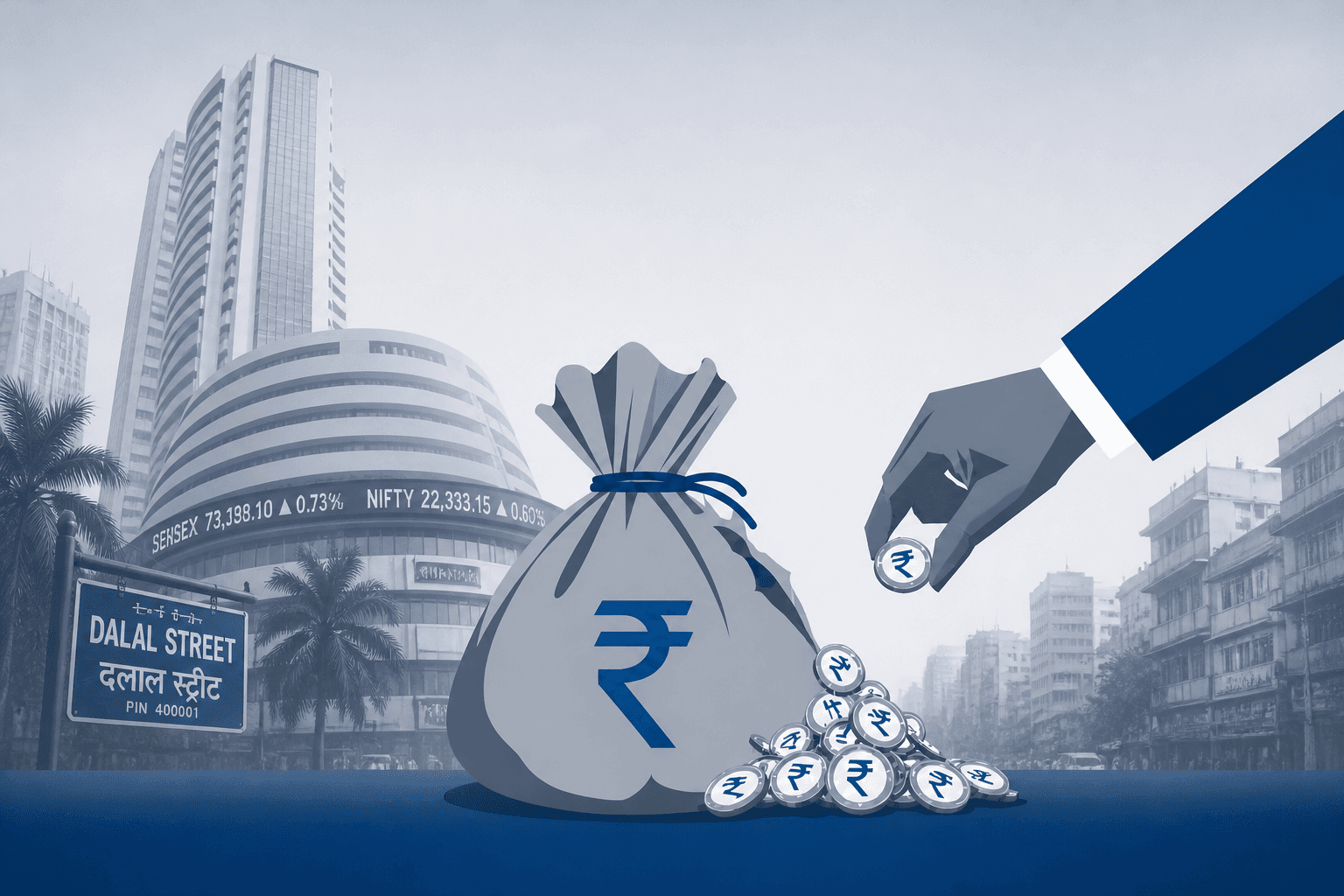
Irrespective of what direction the markets take from hereon, it is useful to remember that the main characters in equity investing are the investor and the owner/management of the company. Successful investing requires the former to back the latter’s enterprise and hard-work, with ‘patience’.
What does the data indicate?
The % shareholding by foreign portfolio investors (FPIs), of the Indian stock markets is around 14% (October’26), down from a peak of 23%+ in 2015.
The net flow (sales minus purchases) for the last 2 full financial years and current financial year are as follows:
- FY 24-25: positive net flow of 20,000 crores
- FY 25-26: negative net flow of 1,52,000 crores
- FY 26-27 (April to date): negative flow of 2,00,000 crores
These numbers include purchases made via IPOs (initial public offers) & QIPs (qualified institutional placements).
No one factor can be singled out — it will be therefore useful to retrace and go back to the period July-September’24 when all seemed hunky-dory, before the tide turned.
- Valuations: Valuations (P/E multiples) had gone up considerably, and Indian markets were the most expensive in the world amongst the major economies, excluding the USA. That the ruling party did not reach the majority mark when the expectation on the street was 400+ put a further question mark on the sustainability of the valuations.
- Tax regime: As FPIs started to sell, the realisation that India was taxing their capital gains hit home. The tax had been introduced in 2018, but you pay tax when you redeem. And to make matters worse, India further increased the capital gains tax in July’24 budget.
- Tariffs: Trump announced trade tariffs in April’25 which singed markets world over. The trade deal with India is still pending, which also has been an overhang.
- AI story: AI story around that time had started to gather momentum and capital flow started moving towards those countries which provided exposure to AI plays. India had no real AI play and its tech majors, which had commanded a premium took the brunt.
- US-Iran: By early this year, India had seen a healthy time-correction and a case for investing was getting stronger. However, USA decided to attack Iran. Tensions continue to simmer on that front.
- Oil dependence: With > 85% dependence on oil imports, India has been impacted both in terms of rising inflation and weakening currency.
- Weakening Rupee: To defend the rupee, RBI announced a special Fixed Deposit scheme to attract NRIs by taking the cost of hedging on its balance sheet. The scheme raised USD 140 billion, however that has not (yet) had the desired effect. RBI has already exhausted ~ 50% of that amount in defending the Rupee.
- Rising Interest rates: US Central bank raised rates in September’26 (and it is expected they might do more). This has put pressure on the Rupee.
In summary: valuations, AI, tax regime, currency, geopolitics.
Where are we on these factors?
- Valuations: Q2 corporate results have been strong. Nifty 50 companies profit growth is projected around 21% to 27% year-on-year, on the back of ~ 18% growth in Q1. As a result, valuations (~ 19 times) are now looking much better, which sits below its long-period average. There has been both a time & price correction, and this does lay the ground for a recovery in sentiments.
- AI: We are seeing signs of weakening in the AI momentum, which can lead to capital flows going back to traditional businesses.
- Tax regime: There is an increasing possibility of a change in tax regime (for FPIs). Though indications are that any change will happen in the budget. The messaging however is important, that “foreign capital is welcome” and the country’s equity markets cannot depend on “domestic capital (SIPs)” alone.
- Currency: This is one of the weak links and might continue to hamper any reversal. It is also linked to rising yields in USA and rising tensions in middle east.This explains the clamour from the investment industry to make the tax regime (the 3rd factor) FPI friendly, now. Given that 1st & 2nd factor are moving in favour of Indian markets, if this too gets addressed, it can force FPIs to re-think their exit, which in turn takes the pressure off the currency.
- Geo-politics: This is beyond anyone’s control – the joker in the pack!
Two more points which need elaboration
There are two more points which need elaboration, in the absence of which, the above explanation can be held as "simplistic".
Governance concerns
This point is debatable, but it must be put out there. I was listening to an interview of Ajit Dayal (a veteran investor and fund manager, Founder of Quantum Advisors) - known for actively representing & protecting minority investor interest. His firm computes an "integrity score" of major indices based on some 200 parameters, as per which, about 30% of the Nifty-50 is un-investible. He says that the Europeans are very particular about it and hence while investing in say S&P 500, they “customise the index” by removing companies like Meta & Tesla. Could this be one factor as well which we are not appreciating? You can click here to listen to the interview – this specific point is on the 30th minute mark.
Margin Trade Funding (MTF)
Margin Trade Funding (MTF) book has gone up 6 times in 3 years, from less than 25,000 crores in FY’23 to more than 1,50,000 crores now. Combined with the Loan Against Share book, the total 1,95,000 crore is ~ 0.87% of India’s free float market capitalisation - the highest level ever recorded in the Indian financial system. That this book is largely concentrated in small-to-mid-cap stocks and has been built at a time when markets have been flat-to-negative makes it a potential trigger point should the correction in small and mid-cap stocks seen recently worsens. We need to watch out for this.
(MTF is a credit facility provided by stockbrokers that allows investors to buy shares by paying only a fraction of the total cost upfront, while the broker funds the remaining amount. The upfront payment you make is called the Margin, and the shares you buy act as collateral for the loan provided by the broker).
What happens next?
Wish we had a crystal ball. We do not. So much depends on how the above factors play out. Markets do not work on fundamentals alone. On that count, many businesses are at attractive levels. Markets depend on flows, sentiments, technicals, interest rates, currency et al.
Also, from an investor's standpoint, so much depends on their specific situation. Their response will hence be very different.
- If you are a long-term investor whose equity allocation is as per your risk tolerance (you will not wilt even if markets do not give returns for some more time and neither, will you wilt if markets further correct) and you are not dependent on the equity part of your portfolio for your near-term expenses: this could be an opportunity to buy more, especially if there is a sharp correction. If you are following a rule-based investing, you should be keeping the re-balancing math ready.
- If, however, you are over-allocated to equity (beyond what your risk tolerance and/or risk need suggests) and/or you are dependent on the equity part of your portfolio for your near-term expenses: you might want to recalibrate your approach to investing. You should consider reaching out to a fee-only advisor who can help you do so.
Taking a very long-term-view
Equity investing necessitates you to take a very long term view. 10/15 years+. After all you are betting on an underlying business and the ability of the management/owners to navigate through ups and downs and grow the business at a reasonable clip. Anything less will fall in the realm of speculation.
The intervening periods will test your patience. We are in such a period. You will hear all kinds of arguments from market participants. Some giving hope and some invoking fear. However, it is important to remember that they are not the ones in control.
The two main characters are - the investor (i.e. you) and the underlying business (management/owner). The latter puts in the hard work, perseverance, enterprise. The former needs to back it up with patience.
Disclaimer
Investment in securities is subject to market risks and investor should read all related documents before investing.
We do not guarantee performance or provide any assurance of any return.